Beauty Tech Devices in 2026: What Sydney Clients Should Use at Home — and What Belongs in Clinic
Beauty in 2026 is becoming more technological, but also more sensible. After years of maximalist routines, viral hacks and aggressive treatment cycles, Sydney clients are asking a better question: which tools actually help my skin, and which ones are just expensive noise?
That question matters because beauty technology is everywhere now. LED masks are on bathroom shelves. Microcurrent devices are promoted as at-home lifting tools. Cleansing brushes, ultrasonic spatulas, facial massagers, high-frequency wands and app-based skin scanners all promise clinic-style results from the lounge room. At the same time, professional clinics are investing in more advanced imaging, radiofrequency, laser, skin needling, IPL, HIFU, hydrating infusion systems and LED protocols.
The result can feel confusing. If you already own an LED mask, do you still need LED in clinic? If your phone app says your skin barrier is compromised, should you change your whole routine? If a device tingles, warms or vibrates, does that mean it is working? And if a home tool claims to lift, sculpt, brighten or regenerate skin, how do you know whether it is safe for your skin type?
The short answer: beauty tech can be useful when it supports the skin, but it should not replace diagnosis, treatment planning or clinical-grade procedures. The best results come from a smart combination of professional assessment, targeted in-clinic treatment and realistic at-home maintenance.
This guide explains how to think about beauty tech in Sydney in 2026, what is worth considering, what to avoid, and how SkinSpirit clients can use devices without irritating the skin barrier or delaying more effective treatment.
Why Beauty Tech Is Trending in 2026
Several trends are converging at once.
First, clients are more educated. People want to understand their skin rather than simply buy another serum. They want evidence, before-and-after tracking and personalised plans. Devices feel appealing because they seem measurable and modern.
Second, the beauty industry has shifted toward skin longevity. Instead of chasing dramatic overnight change, more clients want long-term collagen support, barrier resilience, reduced inflammation and healthier ageing. Technology fits into this conversation because tools like LED, imaging and professional energy-based treatments can be used as part of a long-term skin strategy.
Third, home care has become more sophisticated. Many people became comfortable with at-home rituals over the past few years, and brands responded with more devices at lower price points. Some are genuinely helpful for consistency. Others overpromise.
Finally, Sydney clients are busy. If a device can support glow, circulation or treatment maintenance between appointments, that convenience is attractive. The key is knowing where the line is between helpful maintenance and unrealistic replacement.
At-Home Devices vs In-Clinic Devices: The Main Difference
The biggest difference is not just price. It is power, precision, assessment and accountability.
At-home devices are designed to be lower risk for general consumers. They usually use lower energy levels, simpler settings and broad safety limits. This can make them safer, but it also means results are usually subtle and cumulative. A home LED mask may support skin recovery and calmness with regular use, but it will not deliver the same planning, wavelength strategy or treatment integration as a professional LED protocol.
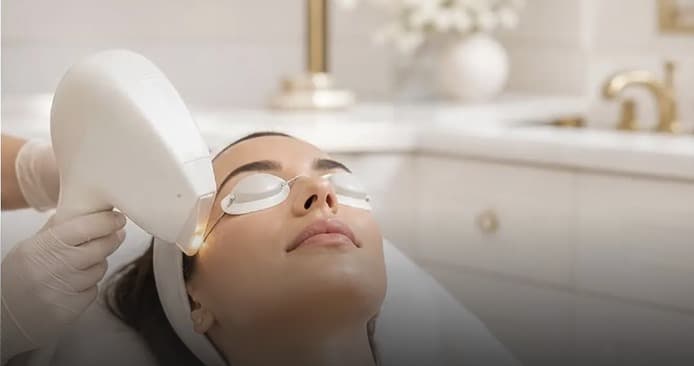
In-clinic devices are different. Professional treatments are selected after consultation, adjusted for skin tone and sensitivity, and sequenced with other treatments. For example, a client with post-inflammatory pigmentation, rosacea-prone redness or a disrupted skin barrier should not be treated the same way as someone with resilient, oily, sun-damaged skin. The practitioner decides not only which device to use, but also whether the skin is ready for it.
That clinical judgement is the part many home devices cannot provide.
LED Masks: Useful, But Not Magic
LED is one of the most popular beauty tech categories because it is non-invasive, comfortable and easy to fit into a routine. Red and near-infrared light are commonly discussed for skin recovery, calmness and collagen support, while blue light is often associated with acne-prone skin.
For many clients, a quality LED mask can be a helpful maintenance tool. It may be especially useful after barrier repair work, during stressful periods, or between professional treatments when the goal is to keep skin calm and consistent.
But there are limits. Results depend on the device quality, wavelength, output, fit, distance from skin and consistency. Many clients use LED sporadically and expect dramatic change. Others combine LED with too many active ingredients, which can confuse the picture when irritation appears.
In clinic, LED is often more valuable because it is part of a plan. It may be used after facials, peels, needling or calming treatments to support recovery. It can also be paired with professional skin assessment so the treatment goal is clear.
Best use at home: maintenance, recovery support and consistency.
Best use in clinic: targeted protocols, post-treatment support and professional sequencing.
Microcurrent and Facial Toning Devices
Microcurrent devices are often marketed as lifting or sculpting tools. They use low-level electrical currents and are usually paired with a conductive gel. Some clients enjoy them because they create a refreshed look and encourage a consistent massage-like ritual.
The realistic expectation is important. At-home microcurrent may temporarily improve the appearance of facial tone or puffiness for some people, but it does not replace injectables, HIFU, radiofrequency, biostimulators or skin tightening procedures. It also requires consistency; using it once before an event is different from using it correctly several times per week.
Microcurrent is not for everyone. People with certain medical devices, pregnancy considerations, active skin irritation, recent injectables or specific health conditions should seek professional advice first. It also should not be dragged aggressively across the skin, especially if the barrier is compromised.
Best use at home: gentle maintenance for clients who enjoy the ritual and tolerate it well.
Best use in clinic: discussion as part of a broader lifting, tightening or facial sculpting plan.
Cleansing Brushes, Ultrasonic Spatulas and Extraction Tools
This category needs caution. Cleansing brushes and ultrasonic spatulas can feel satisfying because they create an immediate sense of smoothness. But Sydney clients with sensitivity, rosacea, acne inflammation, post-treatment skin or barrier damage can easily overdo them.
The skin barrier is not a tile floor. It does not need daily scrubbing. Too much mechanical exfoliation can increase redness, tightness, flaking, breakouts and stinging. If your skin feels cleaner but also more reactive, that is not a good trade.
Extraction tools are even riskier. Picking, pressing and scraping can cause broken capillaries, bruising, post-inflammatory pigmentation and scarring. For acne-prone or melanated skin, aggressive home extraction can leave marks that take months to fade.
In clinic, extractions are performed with skin preparation, hygiene and judgement. Sometimes the right decision is not to extract at all, but to calm inflammation first.
Best use at home: very occasional, gentle cleansing support if your skin is resilient.
Best use in clinic: professional congestion management, acne planning and barrier-safe exfoliation.
Skin Analysis Apps and AI Scanners
Skin analysis technology is improving quickly. Apps and imaging tools can help track visible changes such as pigmentation, redness, pores, texture or hydration patterns. They can also make consultations more engaging because clients can see what is changing over time.
However, an app is not a diagnosis. Lighting, camera quality, makeup, sunscreen, facial expression, menstrual cycle, sleep, hydration and recent treatments can all affect the image. A phone-based scan may identify a possible pattern, but it cannot fully understand medical history, medication, lifestyle, skin feel, sensitivity or treatment suitability.
Where skin scanning is useful is in tracking progress. If the same imaging conditions are used over time, it can show whether pigmentation is softening, redness is calmer or texture is improving. In a clinic, imaging becomes more powerful because the practitioner can connect the visual data with what they see and feel during consultation.
Best use at home: progress tracking and awareness.
Best use in clinic: consultation, treatment planning and objective monitoring.
High-Frequency Wands and Acne Devices
High-frequency devices are popular for blemish-prone skin. Some people use them as a spot treatment when congestion appears. The appeal is understandable: acne can be frustrating, and clients want something active they can do at home.
But acne is not only a surface issue. It can involve oil flow, follicle congestion, bacteria, inflammation, hormones, stress, barrier damage and product choices. A device may help some clients as an occasional supportive step, but it will not replace a proper acne plan.
Overuse can dry or irritate the skin. This is especially true when high-frequency devices are combined with benzoyl peroxide, retinoids, acids or harsh cleansers. The more inflamed the skin becomes, the more likely it is to mark.
Best use at home: occasional, cautious spot support for suitable skin.
Best use in clinic: acne assessment, product plan, LED support, peels where appropriate and referral when needed.
Facial Massage Tools, Gua Sha and Cooling Globes
Not all beauty tech needs to be high-tech. Facial massage tools, cooling globes and gua sha stones remain popular because they support lymphatic flow, reduce puffiness and create a calming ritual. In 2026, this fits the wider trend toward nervous-system-aware beauty and calmer skin.
These tools can be beautiful when used gently. The problem is pressure. More pressure does not mean more sculpting. Aggressive scraping can irritate the skin, worsen redness or create bruising. Tools should glide easily with a suitable product, and the skin should look fresh — not angry — afterwards.
They are best thought of as wellness-supportive, not structural lifting tools. If the concern is true laxity, volume loss or deeper collagen decline, professional treatments will be more relevant.
Best use at home: relaxation, puffiness support and gentle routine consistency.
Best use in clinic: lymphatic drainage facials, post-treatment massage when appropriate and holistic skin planning.
When Beauty Tech Can Make Skin Worse
Beauty tech becomes a problem when it encourages over-treatment. Common warning signs include:
- Skin that feels tight, shiny or squeaky clean after device use
- Redness that lasts more than a short flush
- Stinging when applying simple moisturiser
- Increased flaking or rough patches
- Breakouts that appear after introducing multiple tools
- Pigmentation marks after picking, extraction or irritation
- Using a device because it feels productive, not because the skin needs it
The most common mistake is stacking too many interventions: retinoids, acids, vitamin C, exfoliating brushes, LED, peels, masks and facial tools all in the same week. Even good products and devices can become too much when combined without a plan.
If your skin is reactive, the priority is usually to simplify. Stop the extras, return to cleanser, moisturiser and sunscreen, and seek advice before restarting active devices.
How to Build a Smart Beauty Tech Routine
A good beauty tech routine should be boring in the best way: consistent, gentle and purposeful.
Start with one device only. Use it for several weeks before adding anything else. Keep your skincare routine stable so you can tell what is helping and what is irritating. Follow the manufacturer instructions, but also listen to your skin.
Avoid using stimulating devices immediately after strong exfoliation, sunburn, waxing, laser, needling, injectables or active irritation unless your practitioner has cleared it. Treatment timing matters.
Choose devices based on your actual goal:
- Redness or sensitivity: calming facials, barrier repair, LED support and simple home care
- Pigmentation: sunscreen, pigment-safe actives, professional assessment and treatment sequencing
- Congestion: acne-safe routine, professional extractions when needed and careful exfoliation
- Firmness: collagen-stimulating treatments, HIFU/RF/needling where suitable and realistic maintenance
- Puffiness: lymphatic massage, sleep, hydration and gentle tools
- Texture: professional exfoliation or resurfacing rather than daily scrubbing
The goal is not to own every device. The goal is to choose the few supports that match your skin and lifestyle.
What Still Belongs in Clinic
Some results require professional treatment. At-home devices should not replace:
- Skin needling for collagen induction
- Professional peels for pigmentation, acne or texture
- Laser or IPL for redness, pigmentation or rejuvenation
- HIFU or radiofrequency for tightening
- Injectables for muscle movement, volume or structural refinement
- Professional extractions for stubborn congestion
- Assessment of changing moles, lesions or medical skin concerns
- Treatment planning for melasma, rosacea, acne scarring or post-inflammatory pigmentation
This does not mean home devices are pointless. It means they should support the plan, not pretend to be the whole plan.
Sydney Skin Considerations: Sun, Pigment and Sensitivity
Sydney skin has its own context. High UV exposure means pigmentation risk is always part of the conversation. A device or routine that irritates the skin can make pigment more likely, especially in deeper skin tones or melasma-prone clients.
This is why sunscreen remains the most important beauty technology you own. No LED mask, microcurrent device or facial tool can outwork inconsistent SPF. If your goal is brighter, calmer, more youthful-looking skin, daily sun protection is non-negotiable.
Humidity, seasonal changes, air conditioning and active outdoor lifestyles also influence the skin barrier. Some clients can tolerate more actives in winter but become reactive in summer. Others struggle with dehydration from indoor heating or air conditioning. A device routine should change with the skin, not stay fixed because the calendar says so.
A SkinSpirit Approach to Beauty Tech
At SkinSpirit, we see beauty tech as part of a bigger skin strategy. The best plan usually starts with three questions:
- What is the main skin concern?
- Is the barrier healthy enough for treatment?
- Which combination of clinic care and home maintenance will get the result safely?
For one client, that might mean professional LED, hydrating facials and barrier repair before any stronger treatment. For another, it might mean pigment-focused planning with sunscreen, actives and IPL/laser discussion. For someone concerned about firmness, it may involve HIFU, RF, needling or injectables rather than relying on a small at-home toning tool.
We also help clients avoid device clutter. If you already own tools, bring them up during consultation. We can help you decide what to keep, how often to use it, and what to pause before or after treatments.
The Bottom Line
Beauty tech is not a gimmick, but it is not magic either. In 2026, the smartest Sydney clients are not chasing every new gadget. They are using technology selectively: professional devices for meaningful change, home devices for gentle maintenance, and expert guidance to protect the barrier.
If your skin is calm, consistent and improving, your device routine may be working. If your skin is red, tight, stinging, breaking out or becoming more pigmented, it may be time to simplify and get a professional opinion.
The future of beauty is not about replacing practitioners with gadgets. It is about combining thoughtful technology with experienced hands, good judgement and a skin plan that respects your biology.
Ready to work out which beauty tech belongs in your routine? Book a consultation with SkinSpirit and we will help you build a plan that is modern, realistic and kind to your skin.